Curated lists
Push your luck: the card game for eighteen people, and when to stop
One more flip is always tempting. That is the whole game.
· 6 min read
Why push-your-luck games work for a crowd
Most card games buckle past six people: the turns get long, the cards run out, and the people waiting drift to their phones. Push-your-luck games are built the other way round. Every turn is a single decision — one more, or stop? — so a turn takes seconds, and everyone at the table is watching the person deciding, because they are rooting for them to bust.
Don't Bust is PartyDen's game in that family, for three to eighteen players. It takes about a minute to explain and a round is over before anyone loses interest.
How a round of Don't Bust plays
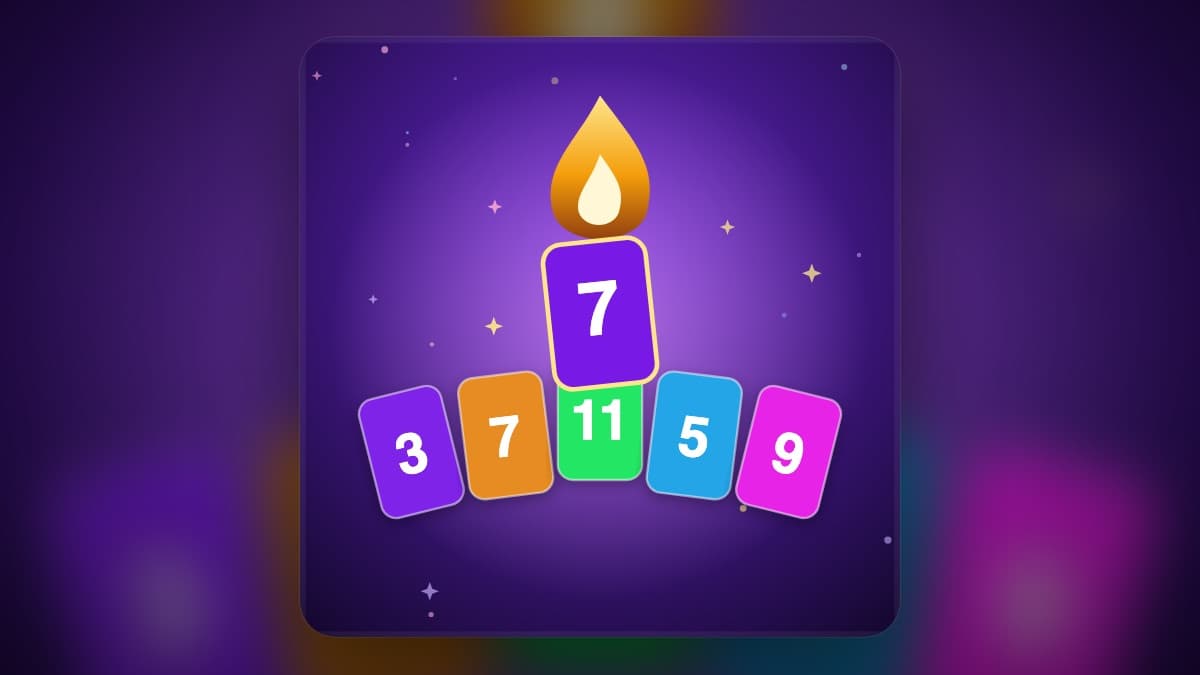
On your turn you flip a card into your line, or you stay and bank what your line is worth. Your first card of the round is always a flip — that is the deal. The catch: flip a number you already have in your line, and you bust. A busted line scores nothing for the round.
The deck is lopsided on purpose. There is a single 1, two 2s, three 3s, and so on up to twelve 12s. High numbers score more and are much more likely to come again, so a line with a 12 and an 11 in it is worth a lot and dangerous to push.
Specials change the rhythm. Bonus cards add points, a ×2 doubles your numbers, a lucky charm takes one bust for you, and a lock lets the player who flips it stop someone else at once — usually the leader, just before they get greedy. And if anyone collects seven different numbers, the round ends for everybody, with a bonus for them.
| Card | How many | What it does |
|---|---|---|
| Numbers 1 to 12 | As many as the number | Score their value; a repeat busts you |
| Zero | One | Counts as a number, scores nothing |
| Bonus (+2 to +10) | One of each | Added to your banked score |
| ×2 | One | Doubles the numbers in your line |
| Lucky charm | Three | Takes one bust for you |
| Lock | Three | Stop any player still in; they bank |
When to stop: the honest maths
The bust risk on your next flip is simple to state: it is the share of the cards nobody has seen yet that match a number already in your line. With one low number in your line it is small. With four or five numbers, several of them high, it can be a third or more.
Most players stop too late on a good line and too early on a weak one. A useful habit is to stay once your line is worth more than about twenty-five points, unless you are behind and the round is your last chance. The app shows your bust risk before every flip, counted from the cards everyone has seen, so the decision is about nerve rather than arithmetic.
Running it for a big group
Everyone plays on their own phone, so a room of eighteen needs nothing but a link. Turns run on a short clock, which keeps a big group moving; if somebody has wandered off, the host can stay for them. Play to 200 for an evening game, 100 for a quick one between other games.
For a big group that wants something with even less thinking, Pass the Chips is pure luck with dice. For a smaller table that wants more control, FlipOut is the fast shedding game and Liars Dice is push-your-luck with bluffing on top.
Questions people ask
How many people can play Don't Bust?
Three to eighteen. Every card is face up and turns take seconds, so it holds a big group well.
What makes you bust?
Flipping a number you already have in your line this round. Bonuses, ×2, charms and locks never bust you.
Is Don't Bust the same as Flip 7?
It is the same kind of push-your-luck game, with its own cards, specials and name.
How long does a game take?
A game to 200 usually takes 15 to 30 minutes, depending on how many people are playing.
The games in this post
Don't Bust
Flip a card or stay. A number you already hold busts your round. Seven different numbers and everyone stops.
- Call friendly
- High energy

FlipOut
A fast, colorful card battle. Match, block, flip and dump your hand before everyone else.
- Quick
- Call friendly
Pass the Chips
Three chips each, three dice, no decisions: pass left, pass right, lose one to the pot. Last one with chips wins.
- Quick
- Call friendly

Liars Dice
Bid on dice you cannot see, and call a bluff to make someone lose one.
- Call friendly
More like these on Games for Large Groups.
Ready to try it?
Start a room in a few taps. No account, nothing to install.