Curated lists
Card games like UNO, and the stacking argument settled
Match a colour or a number, dump your hand — and let the server decide whether a Draw 2 stacks.
· 5 min read
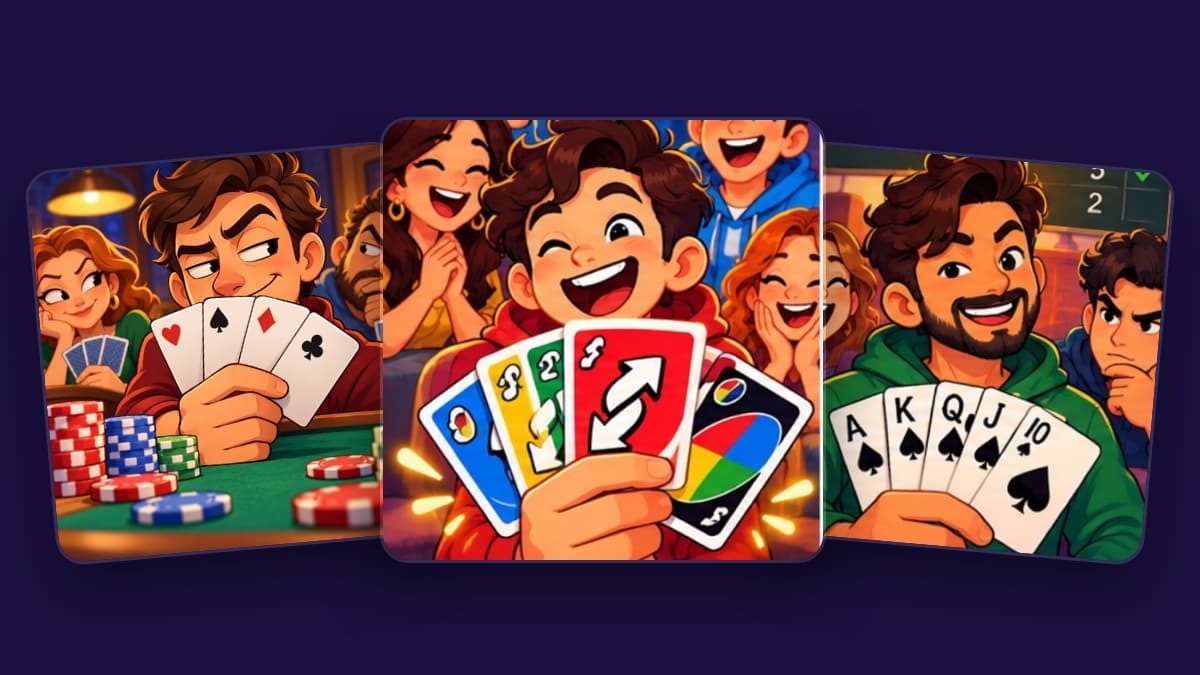
UNO is a brand; the game is older
UNO belongs to Mattel, which publishes the deck and an official app. If your group wants UNO itself — the name, the cards, the official rules — that is where to go, and a boxed deck on a table is still the best way to play it in one room.
The game underneath is much older. Match the colour or the number on the pile, play an action card to hurt the next person, and be the first to empty your hand: that is the shedding family, which goes back to Crazy Eights. FlipOut is PartyDen's own game in that family, with its own cards and its own rules, and no connection to Mattel. It exists for the nights a deck cannot reach: a group on a video call, a cousin in another city, a table where somebody always "accidentally" sees the next hand.
The cards, and what each one does
Everyone is dealt seven. The first card turned up is always a number, so nobody starts the game owing anything. On your turn you play a card that matches the colour or the number on top, or a wild. If nothing fits, you draw one; if the card you drew fits, you can play it straight away.
You cannot draw while you hold a card that plays. That one rule takes the slow-play out of the game: drawing is not a way to sit on a hand you are saving.
| Card | How many | What it does |
|---|---|---|
| Numbers 0 to 9 | 76, in four colours | Match the colour or the number |
| BLOCK | 8 | The next player loses their turn |
| FLIP | 8 | Play reverses direction; with two players, you go again |
| DRAW 2 | 8 | The next player owes two cards |
| SHIFT | 4 | A wild: you choose the colour |
| FLIPOUT | 4 | A wild: you choose the colour, and the next player owes four |
The stacking argument, settled before it starts
Every family that plays UNO has had the fight. Somebody plays a Draw 2, the next person slaps down another Draw 2 and says the first one now owes four, and half the table says that is not a rule. The half who say so are right about the box: in the printed rules, a Draw 2 makes the next player draw and miss their turn, and that is all. The other half are right about how almost everybody actually plays.
FlipOut picks a side and writes it into the server, so nobody has to win the argument. When a DRAW 2 or a FLIPOUT comes your way you owe the cards, and you can either take them — which ends your turn — or answer with a FLIPOUT, which adds four and passes the whole pile-up to the next person. A DRAW 2 then a FLIPOUT is six. Two FLIPOUTs are eight. A DRAW 2 cannot answer anything, not even another DRAW 2.
That last line is the design. If any Draw 2 can answer any Draw 2, a pile-up is just a count of who happens to hold the most twos, and with eight of them in the deck it happens every few turns. Only four cards in the deck can answer, so when a pile-up grows to eight or twelve, somebody really did save a FLIPOUT for that moment, and the room hears about it.
There is one more house rule, and it is off unless the host turns it on: call your last card. With it on, a player going down to one card has to tap "Last card!" before the next player moves, and anyone who catches them first makes them draw two. Some rooms love it; in others it turns every turn into a race to tap, which is why it is a choice.
Why play it on phones at all
In one room with a deck, you do not need to. The case for phones is everything a deck cannot do. Your hand only ever exists on your own screen, so nobody sees it over your shoulder or on a video call's camera. A pile-up is counted by the server, so nobody draws three when they owed six. The turn moves on a clock, so the player who goes to make tea mid-turn draws a card and the game carries on without them. And when somebody's phone drops off the Wi-Fi for a second, they come back to the same cards on the same turn.
It is fast: a deal takes five to fifteen minutes, and the host can set up to five deals for a longer night, with each deal's points added up. The winner of a deal scores the points left in everyone else's hands, and a FLIPOUT still in yours when somebody goes out is fifty of them — so even a hand you are losing is worth emptying.
What to play after it
FlipOut is a good opener because everyone already knows how it works. Once the room is warm, three card games use the same phones for something with more bite.
Bluff is the lying game, also called Cheat: cards go down face down with a claim about what they are, and anyone can call you a liar. It is loud in exactly the way FlipOut is, and the room gets better at it every round. Judgement, Kachufool or Oh Hell, asks you to bid exactly how many tricks you will take, and a tidy hand you bid wrong scores nothing. Call Break is the four-player trick game with spades always trump, which is the one to pick if the group already plays it at weddings.
All three sit in the same room as FlipOut, so the host switches game and everyone stays where they are. The rest of the card games are listed together.
The games in this post
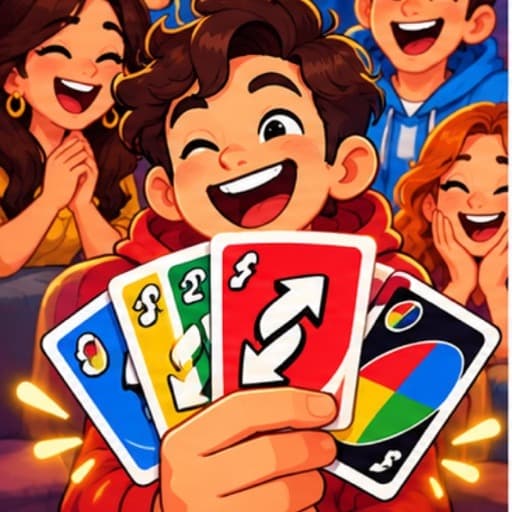
FlipOut
A fast, colorful card battle. Match, block, flip and dump your hand before everyone else.
- Quick
- Call friendly
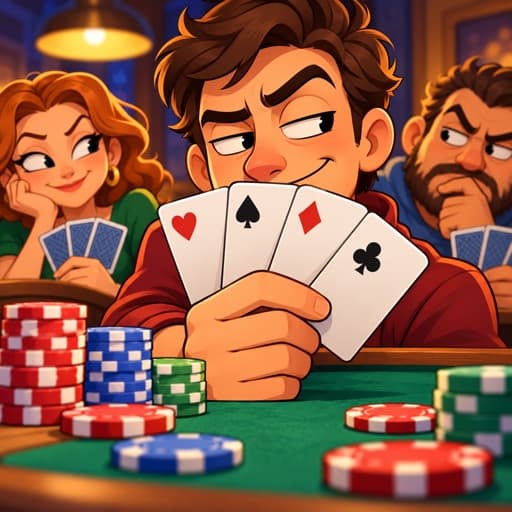
Bluff
Lie about the cards you played — and catch everyone who does.
- Call friendly
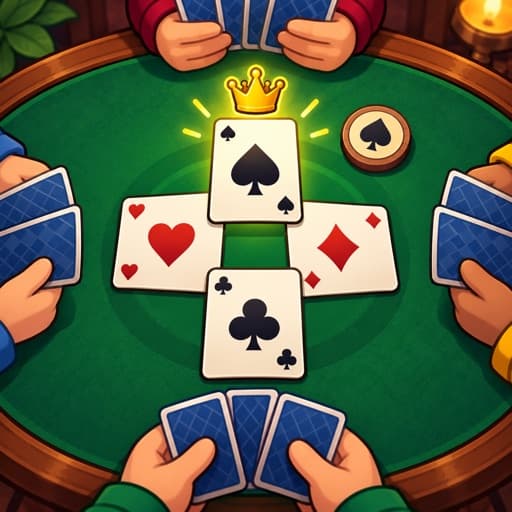
Judgement
Bid exactly how many tricks you will take. One over or under and you score nothing.
- Call friendly
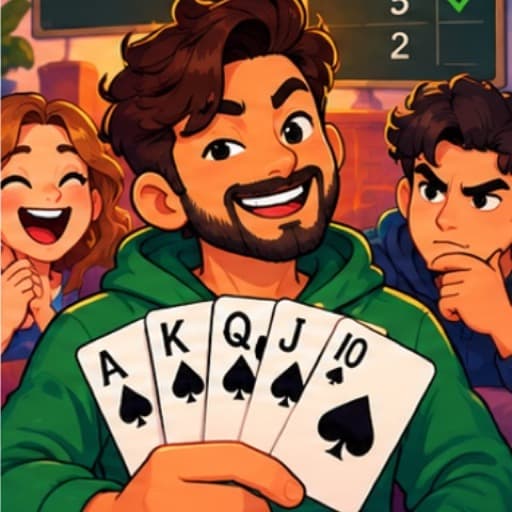
Call Break
Call your tricks, spades always trump. Make your call or lose it. Five hands, highest total wins.
- Call friendly
More like these on Card Games.
Ready to try it?
Start a room in a few taps. No account, nothing to install.