Curated lists
Diwali card games without the money
Taking the money out of teen patti leaves very little. Change the game, not just the stakes.
· 7 min read
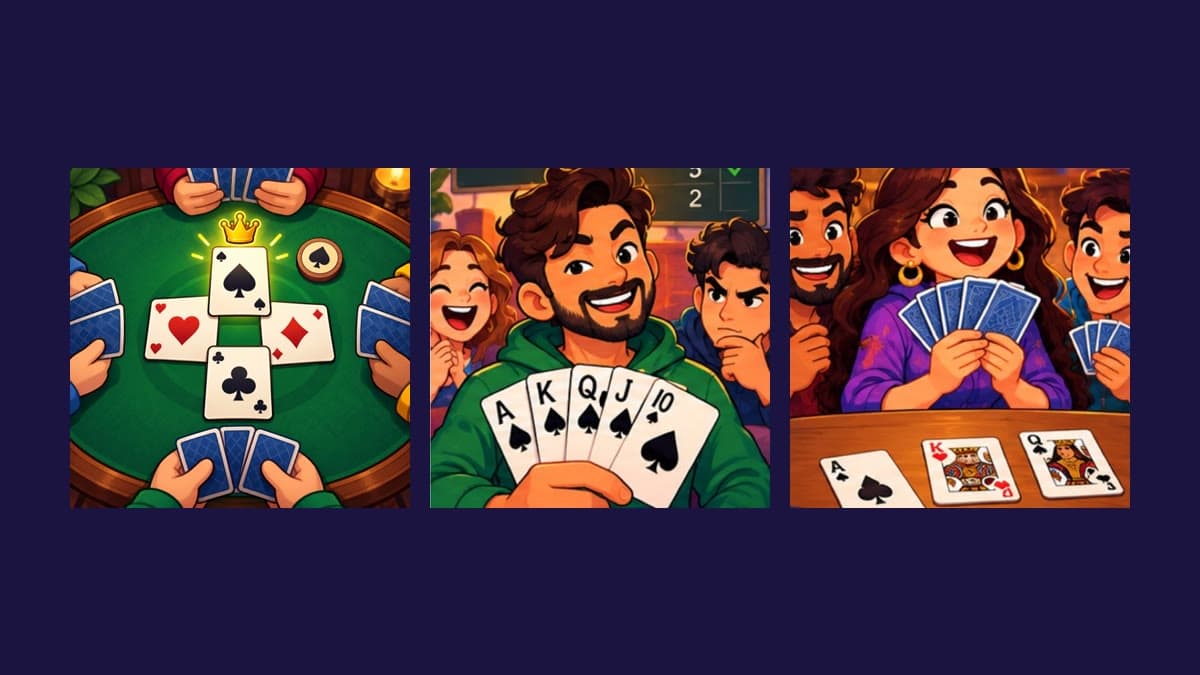
Why the money is there in the first place
In a lot of houses the Diwali card table means teen patti, flash or rummy, and coins or notes in the middle. Some families like it that way. Others have a table with children watching, a relative who would rather not, or a host who simply does not want the evening to be about who lost what.
The usual compromise is to play the same game for matchsticks, and it rarely lasts. Teen patti is a betting game. Take the money away and what is left is three cards and a lot of waiting, so the table drifts off within half an hour. The money was not decoration. It was the game.
The fix is to change the game rather than the stakes. The games below all carry their tension in the cards: a bid you have to make exactly, a trump nobody else knows, a ten that decides the hand. They are just as tense for points.
If you want the all-or-nothing feeling: Judgement
Judgement, which many families call Kachufool, is the closest thing to a bet without one. Each round you say exactly how many tricks you will win, and you score only if you hit it. Over by one and you get nothing. The last person to bid cannot make the totals add up, so somebody at the table is always going to miss.
It seats three to six, the hand gets one card smaller every round until the last is played with a single card, and every round has the moment where somebody needs one more trick and everybody else knows it. That is the feeling the money used to supply.
Four at the table: Call Break, Court Piece, Twenty-Nine, Seep, Mendikot
Most of the classic Indian card games are for exactly four, and they are the ones a table of uncles already knows. The difference between them is where the pressure sits.
Call Break is everyone for themselves: spades are always trump, you call how many tricks you will take, and you must beat the winning card if you can. It is the easiest of the four-player games to teach to someone who has never played.
Court Piece, also called Rang, is partners. The trump is named from the first five cards before the rest are dealt, and a side that takes the first seven tricks wins a court. It is a long game on purpose, so start it early.
Twenty-Nine adds an auction: the side that bids highest names a trump in secret, and nobody else knows what it is until someone cannot follow suit. Mendikot is about the four tens, and the trump is not chosen at all; it is set by the first card played by someone who cannot follow suit. Seep is not a trick game but a capture game, building and breaking houses on the floor, and it is the one with the most arguing about what counted. Here the server lists every legal move, so the arguments are about strategy instead.
When the table is a mix of ages
Bluff seats three to eight and needs no knowledge of trump or tricks: you play cards face down, say what they are, and anyone can call you a liar. Children are very good at it and grandparents are better.
FlipOut is the fast one for when attention is short: match the colour or the number, play the action cards, empty your hand first. A round takes a few minutes, and it plays with two.
Pick by headcount
The quickest way to choose is to count the people who actually want to play cards. The four-seat games need exactly four, so a fifth person is the moment to switch to Judgement or Bluff rather than make someone sit out.
| Game | Players | Length | Feels like |
|---|---|---|---|
| Judgement | 3 to 6 | 30–50 min | A bet you have to land exactly |
| Call Break | Exactly 4 | 25–45 min | Everyone for themselves, spades trump |
| Court Piece | Exactly 4 | 30–60 min | Partners, a long match |
| Twenty-Nine | Exactly 4 | 25–45 min | An auction and a hidden trump |
| Mendikot | 4 or 6 | 15–30 min | Partners fighting over the tens |
| Seep | 2 or 4 | 30–60 min | Capturing and building on the floor |
| Bluff | 3 to 8 | 15–30 min | Lying with a straight face |
| FlipOut | 2 to 8 | 5–15 min | Fast, colourful, good for children |
Making points matter
Points work when the room can see them. Every game here keeps a running leaderboard, and a table that has been playing for an hour cares about it more than you would expect. Say at the start how many rounds or courts you are playing, so the last hand means something.
If the table wants a stake, make it one the whole house can see: the loser serves the sweets, the winner picks the next game, or the bottom two do the dishes. It keeps the edge on the last hand without anyone going home lighter.
And when the card players need a break, the rest of the house is probably at the other game of the evening. There is a guide to running a Diwali Tambola night too.
The games in this post

Judgement
Bid exactly how many tricks you will take. One over or under and you score nothing.
- Call friendly

Call Break
Call your tricks, spades always trump. Make your call or lose it. Five hands, highest total wins.
- Call friendly

Court Piece
Rang with a partner: name trump from five cards, take seven tricks, and string the wins into a court.
- Call friendly

29
Bid for trump with a partner. Jacks are worth three, nines two, and the trump stays hidden until someone cannot follow suit.
- Call friendly

Seep
Capture the floor with a partner: match and add cards, build houses, and sweep the table for a seep.
- Call friendly

Mendikot
Win the tens with your partner. No trump until somebody cannot follow suit, then their card names it.
- Call friendly

Bluff
Lie about the cards you played — and catch everyone who does.
- Call friendly

FlipOut
A fast, colorful card battle. Match, block, flip and dump your hand before everyone else.
- Quick
- Call friendly
More like these on Diwali Party Games.
Ready to try it?
Start a room in a few taps. No account, nothing to install.