Game guides
Teen Do Paanch rules, and why three players is the right number
Five tricks, three tricks, two tricks — and a card pulled from whoever fell short.
· 7 min read
A trick game built for three
Most trick games want four players, which leaves a group of three either sitting out or playing a game that was never designed for them. Teen Do Paanch — 3-2-5, or 2-3-5 depending on who taught you — is the exception that families across India and Pakistan play exactly because it needs three.
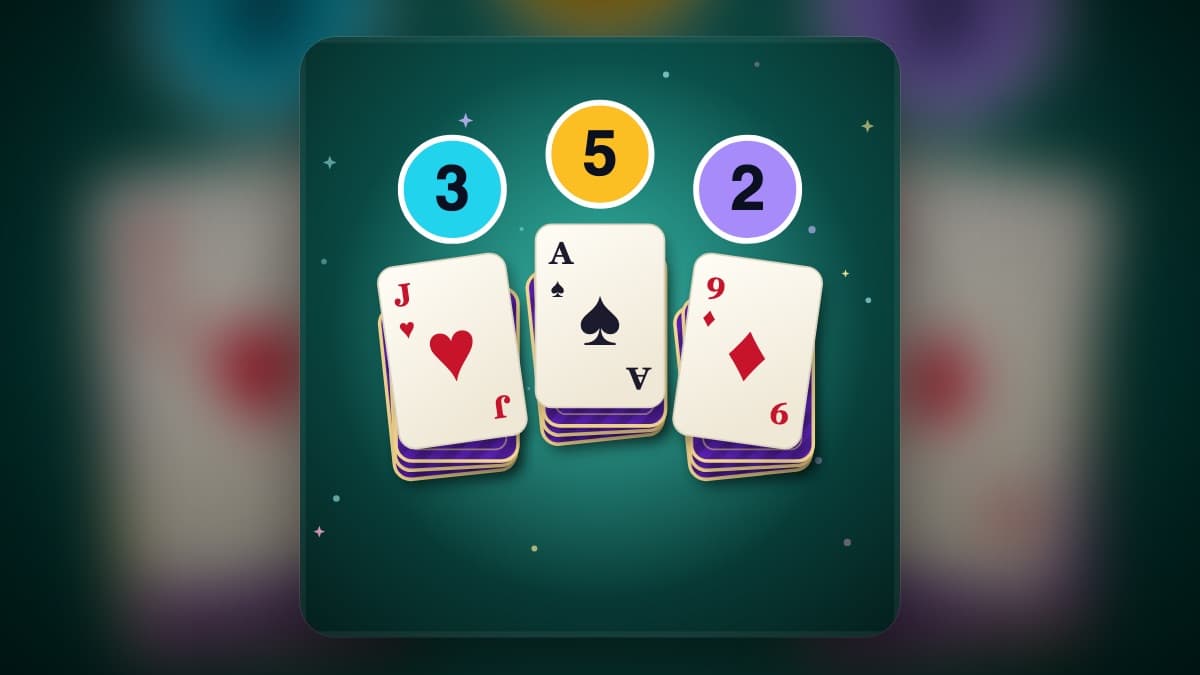
The idea is in the name. Every deal has ten tricks, and the three players have different targets that add up to ten: the player after the dealer must take five, the next player three, and the dealer two. The targets rotate with the deal, so everyone takes every role in turn.
The deck and the deal
The game uses thirty cards: the ace, king, queen, jack, ten, nine and eight of every suit, and the seven of spades and the seven of hearts. Aces are high. Each player gets ten cards.
The deal is the clever part. The cards come out in batches, and the player who needs five tricks gets to look at their first five cards before the rest are dealt. From those five, they name the trump suit. Everyone watches them think about it, because it is a real gamble: a suit that looks strong in five cards can turn out thin in ten.
The app deals the first five, keeps the rest of the pack hidden until trump is named, then deals everyone their remaining five. Nobody can see a card they should not, and nobody has to deal in awkward batches.
Playing the tricks
The five-trick player leads first. You must follow suit if you can; if you cannot, you may play any card, trump included. The highest trump wins a trick; if no trump was played, the highest card of the suit led wins. The winner leads the next trick, and all ten are played.
Because the targets differ, the same hand plays very differently depending on your seat. The dealer, needing only two, can afford to throw away high cards and spoil the five-trick player's count. The five-trick player has to fight for nearly every trick, which is why they get to choose trump.
| Seat | Tricks needed | Their job |
|---|---|---|
| Player after the dealer | 5 | Names trump from five cards and leads |
| The next player | 3 | The swing seat: helps or blocks |
| The dealer | 2 | Can spend high cards to break the five |
The pull: why one good deal makes the next one better
This is what gives the game its memory. If you took more tricks than your target, then at the start of the next deal you pull one card from a player who fell short — one card for each trick over. You take it unseen, at random, and then you give back any card from your own hand, except the one you just took.
A good deal therefore strengthens your next hand and weakens your rival's, and a bad deal follows you. It is a small rule with a big effect on how cautious or bold people are.
At a home table the pull is fiddly: fanned cards held so only one person sees them, the wrong card handed back, the order forgotten. In the app, a pull happens on the two phones involved and nowhere else. The puller is told which card they got; the room only sees who pulled from whom.
Scoring, and how long a game lasts
Casual tables often keep no score at all and simply play until dinner. For a game with a winner, PartyDen scores each deal as your tricks minus your target: making exactly your number is zero, two over is plus two, one short is minus one. After the host's number of deals, the highest total wins. Six deals is a good default, because it gives every player each target twice.
A deal takes three or four minutes, so a game of six runs about twenty to forty minutes.
Other games for a group of three
Three people is not a small party, it is a different one. Judgement works well with three and stretches to six. Bhabhi plays from three upward and is louder and sillier, a good change of pace after a few deals of 3-2-5. And Bluff is the card game for when the group would rather lie than count.
Questions people ask
How many cards are in a Teen Do Paanch deck?
Thirty: ace down to eight in all four suits, plus the seven of spades and the seven of hearts.
Who needs five tricks in 3-2-5?
The player after the dealer. The next player needs three and the dealer needs two, and the targets rotate with the deal.
How does the card pull work?
For each trick over your target, you pull one random card from a player who fell short at the start of the next deal, then give back any card except that one.
Can four people play Teen Do Paanch?
No. The five, three and two targets only add up to the ten tricks of a deal with exactly three players.
The games in this post
Teen Do Paanch
Three players, ten tricks: one needs five, one three, one two. Make extra and you pull a card next deal.
- Call friendly

Bhabhi
Follow suit or break it and make someone pick up the trick. Get rid of your cards — the last one holding is the Bhabhi.
- Call friendly
- High energy
Judgement
Bid exactly how many tricks you will take. One over or under and you score nothing.
- Call friendly

Bluff
Lie about the cards you played — and catch everyone who does.
- Call friendly
More like these on Indian Party Games.
Ready to try it?
Start a room in a few taps. No account, nothing to install.