Game guides
How to play Spades, and the rules every table argues about
A partnership, a bid, and a hundred-point penalty hiding in the extra tricks.
· 7 min read
Spades in one paragraph
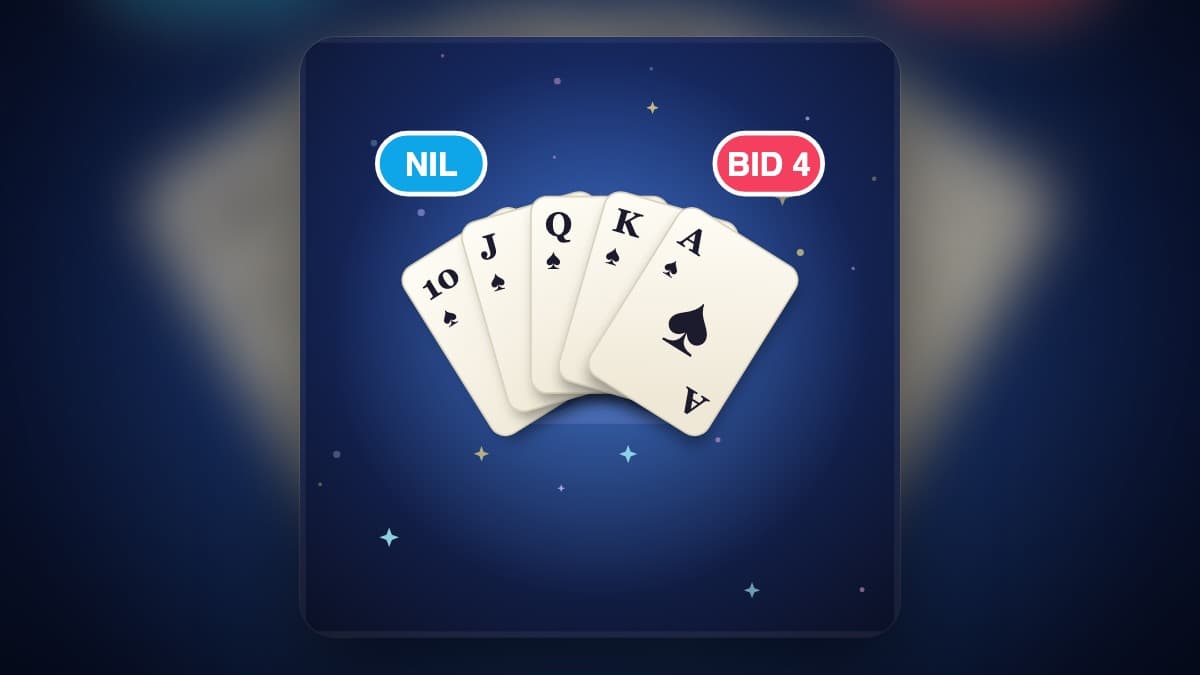
Spades is a trick-taking game for four people in two partnerships, partners sitting opposite. Everyone gets thirteen cards. Before a card is played, each player says how many tricks they expect to take; you and your partner add your numbers together, and that is your side's contract for the hand. Spades are always trump. Take at least as many tricks as you promised and you score; fall short and you lose.
That is the whole game, and it would be a quiet one if it ended there. What makes Spades the card game half of America has played is the extra layer of scoring on top: the bags, the nil bid and the target. Those three are where every family's rules drift apart, and where the arguments start.
Bidding: say a number you can make together
Bidding starts with the player on the dealer's left and goes once round the table. Each bid is a number from 0 to 13, and nobody can change theirs afterwards. Because you hear your partner's bid before or after yours depending on where you sit, the bid is half a promise and half a message: a partner who bids four is telling you they hold something strong, usually high spades.
A sensible first-time bid counts your sure tricks. Aces are usually tricks. A king of spades is close to one. A long run of spades tends to win a trick or two late in the hand, once everyone else has run out. Kings and queens in other suits are maybes, because somebody can trump them. Most new players overbid; the scoring below is why that hurts.
If a whole table is new, put the bid sheet on a screen. On PartyDen every seat shows its bid against the tricks it has taken so far, so "we need two more" is a glance rather than a sum.
The rule that surprises people: spades must be broken
You must follow the suit that was led if you can. If you cannot, you may play anything, including a spade, and a spade beats every other suit. So far, so like any trump game.
The rule newcomers miss is about leading. Nobody may lead a spade until a spade has been played to an earlier trick — usually by somebody who could not follow suit. Until then spades are "not broken". The one exception is a leader whose hand is nothing but spades. The rule exists so the player with a fistful of trump cannot simply lead them from the first trick and pull everyone else's spades out.
This is the most commonly misremembered rule at home tables, and the app settles it: it shows whether spades are broken, and it will not let you lead one before they are.
| Result | What it scores | Why it matters |
|---|---|---|
| Make your contract exactly | 10 a trick of the contract | The aim of a normal hand |
| Make it with extra tricks | 10 a trick, plus 1 a bag | Bags add up across hands |
| Fall short | Minus 10 a trick of the contract | Overbidding is expensive |
| Nil made (no tricks) | Plus 100 | The big swing of the game |
| Nil broken (any trick) | Minus 100 | And the tricks help nobody |
| Tenth bag collected | Minus 100 | Why sandbagging is not free |
Bags: why taking extra tricks can lose you the game
Every trick your side takes beyond its contract is a bag. Each bag is worth a single point when it happens, which sounds like a bonus. But the bags are counted across the whole game, and every time your side reaches ten, you lose a hundred points and the count starts again.
This changes how a good partnership plays. Once you have made your contract, the clever play is often to stop winning tricks — duck under the card that is winning, throw away your high cards — and push the tricks onto the other side, whose contract you might be able to set. Sandbagging, taking many bags on purpose to make sure of a contract, works for a hand or two and then costs you a hundred.
At a real table the bag count is the number somebody forgets, which is how a side ends a game a hundred points worse off than it thought. The app keeps each side's bags on the scoreboard and takes the hundred off itself.
Nil: the most fun bid in the game
A bid of zero is a nil. It is a different kind of promise: you will take no tricks at all, while your partner plays their own bid on their own. Make it and your side scores a hundred. Take even one trick and your side loses a hundred.
The tricks a nil bidder takes count for nothing — they do not help the partner's contract and they are not bags — so a broken nil is a double disaster. A nil is worth trying with a hand of low cards and few spades, and with a partner who is willing to win the tricks you are trying to dodge. When it works it is the play the table remembers.
Blind nil, a nil declared before looking at your cards, is a house rule that changes from table to table, and PartyDen leaves it out to keep one set of rules for everyone. So does the "mercy" rule where a side at minus 200 loses outright.
Spades, Call Break and Hearts: which one tonight
If your group grew up in India, Call Break will feel like home: spades are trump in both, but Call Break is everyone for themselves and forces you to beat the winning card whenever you can. Spades is the partnership version, with no must-beat rule and with bags and nil on top. Families who play Call Break pick Spades up in one hand.
Hearts is the same four-player table turned upside down: no trump, and every heart is a point you do not want. It is the better choice for a group that likes to scheme alone rather than in pairs. And if you want a partnership game with a trump named from five cards, Court Piece is the long, slow-burning one.
A first game of Spades to 300 takes around half an hour to three quarters of an hour, which is the right length for an evening that has other games in it. Play to 500 when the table has settled in for the night.
Questions people ask
How many players do you need for Spades?
Four, in two teams of two, with partners sitting opposite each other. There are three-player and two-player variants, but the standard game is four.
Can you lead spades at the start of a hand?
No. Spades may not be led until a spade has been played to a trick, unless the leader holds nothing but spades.
What happens when you get ten bags?
Your side loses 100 points and the bag count drops by ten. That is why taking extra tricks on purpose is risky.
How many points do you play Spades to?
The usual target is 500, which takes a long evening. Many tables play to 300 or 200 for a shorter game; on PartyDen the host picks.
Does a nil bidder's trick count for their partner?
No. A nil bidder who takes a trick loses 100 for the side, and that trick does not count toward the partner's contract.
The games in this post
Spades
Bid with your partner, spades always trump, and never lead one until they are broken. First side to the target wins.
- Call friendly

Call Break
Call your tricks, spades always trump. Make your call or lose it. Five hands, highest total wins.
- Call friendly
Hearts
Pass three, then dodge every heart and the queen of spades — or take them all and shoot the moon.
- Call friendly

Court Piece
Rang with a partner: name trump from five cards, take seven tricks, and string the wins into a court.
- Call friendly
More like these on Card Games.
Ready to try it?
Start a room in a few taps. No account, nothing to install.