Game guides
The colour-guessing party game, and how to give a good clue
One colour on a grid, one word, and a room that sees colour differently.
· 6 min read
The argument the game is built on
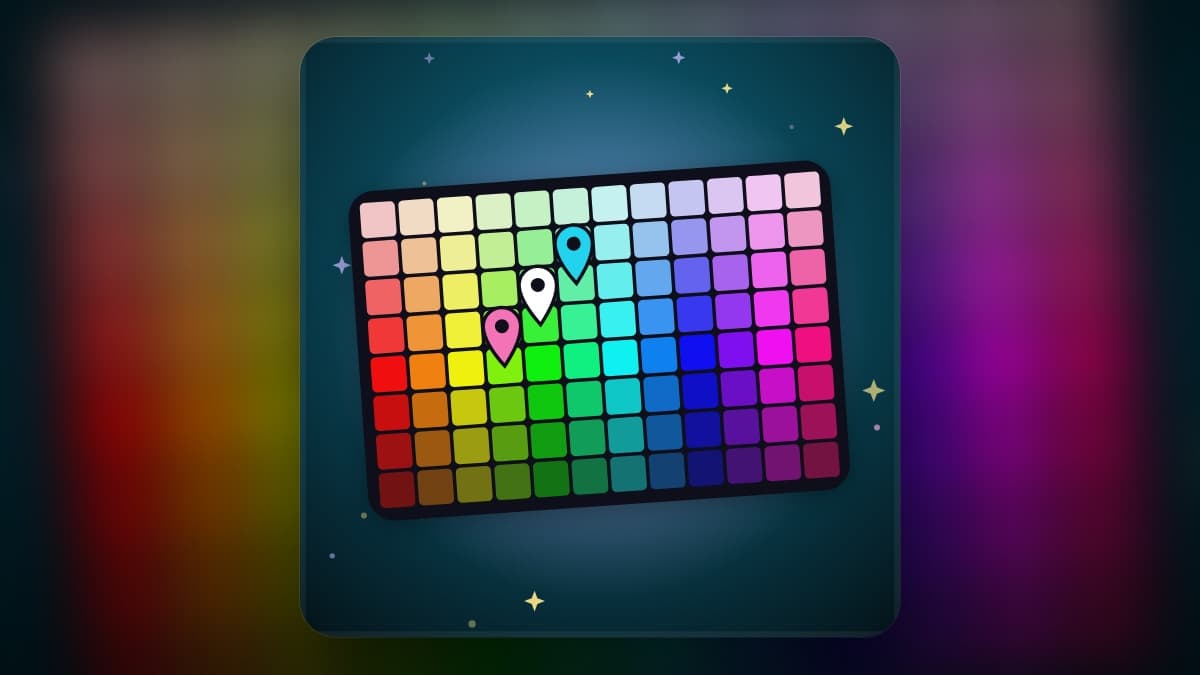
Ask a room whether "ocean" is blue or green and you will get both answers, each said with total confidence. Colour-guessing games are built on that disagreement. Colour Clue is PartyDen's: a grid of ninety-six colours, a clue of one word, and everyone dropping a pin where they think the colour is.
How a round plays
One player is the cue-giver. Their phone, and nobody else's, shows four cells from the grid, and they pick one. They give a one-word clue — "flamingo", "avocado", "bruise" — and every other player drops a pin on the grid. Then the cue-giver adds a second clue of up to two words, and everyone drops a second pin somewhere new.
The reveal shows the colour. A pin on it scores three, a pin next to it two, and a pin two cells away one. The cue-giver scores one for every pin within one cell, so a clever clue pays twice. The seat moves on, and when everyone has given clues, the highest total wins.
| Where the pin lands | Guesser scores | Cue-giver scores |
|---|---|---|
| On the colour | 3 | 1 |
| Next to it | 2 | 1 |
| Two cells away | 1 | 0 |
| Further | 0 | 0 |
How to give a good clue
The first clue should name a thing, not a colour. "Red" points at a whole column; "fire engine" or "tomato" points at a spot in it. Everyday objects with one famous colour work best: "banana", "denim", "pistachio", "mustard".
The second clue is for correcting the room. You have seen where the first pins landed, so use it to push them: if everyone went too dark, "early morning"; too green, "more teal". Two words is enough to say "but lighter".
And pick your colour from the four with the clue in mind. A colour you can name an object for is worth more than a colour that is merely pretty. Numbers and single letters are not allowed as clues, because "C7" is a coordinate, not a clue.
Playing with colour-blind friends
About one man in twelve has some colour-vision deficiency, which is a lot of people at a party. Every cell in Colour Clue has a coordinate as well as a colour — A1 to H12 — drawn on the edges of the grid and read out by screen readers, and the answer is always shown by coordinate. A colour-blind player can follow every round and talk about the grid by position. Like everyone else at the table, they will see some colours their own way, which is the game.
If your group likes this, try these
Wavelength is the same idea with words on a dial instead of colours. One Clue is the co-operative word game where everyone writes a clue for one guesser. And Codenames is the team version of finding the one word that points the room in the right direction.
Questions people ask
Is Colour Clue like Hues and Cues?
It is the same kind of colour-guessing game, with its own grid, scoring and name.
How many people can play?
Three to ten, each on their own phone.
What counts as a clue?
One word the first time and up to two words the second time. No numbers and no single letters.
Can colour-blind players play?
Yes. Every cell has a coordinate shown on the grid and read by screen readers, and answers are always given by coordinate.
The games in this post
Colour Clue
One colour on a grid of a hundred, a two-word clue, and everyone drops a pin. Close counts.
- Call friendly

Wavelength
Place a concept on a spectrum — can your team read your mind?
- Call friendly

One Clue
Everyone writes one clue for the guesser — and every duplicate is thrown away.
- Call friendly
Codenames
Spymasters give one-word clues for their secret agents.
- Call friendly
More like these on Word Games.
Ready to try it?
Start a room in a few taps. No account, nothing to install.